Guide · 3 November 2026
How to use a cafetière: four steps to better coffee
The cafetière is the most forgiving way to make good coffee at home. The ratio, the grind, the timing, the common mistakes and which coffee to buy.
By Meet Your Coffee editors
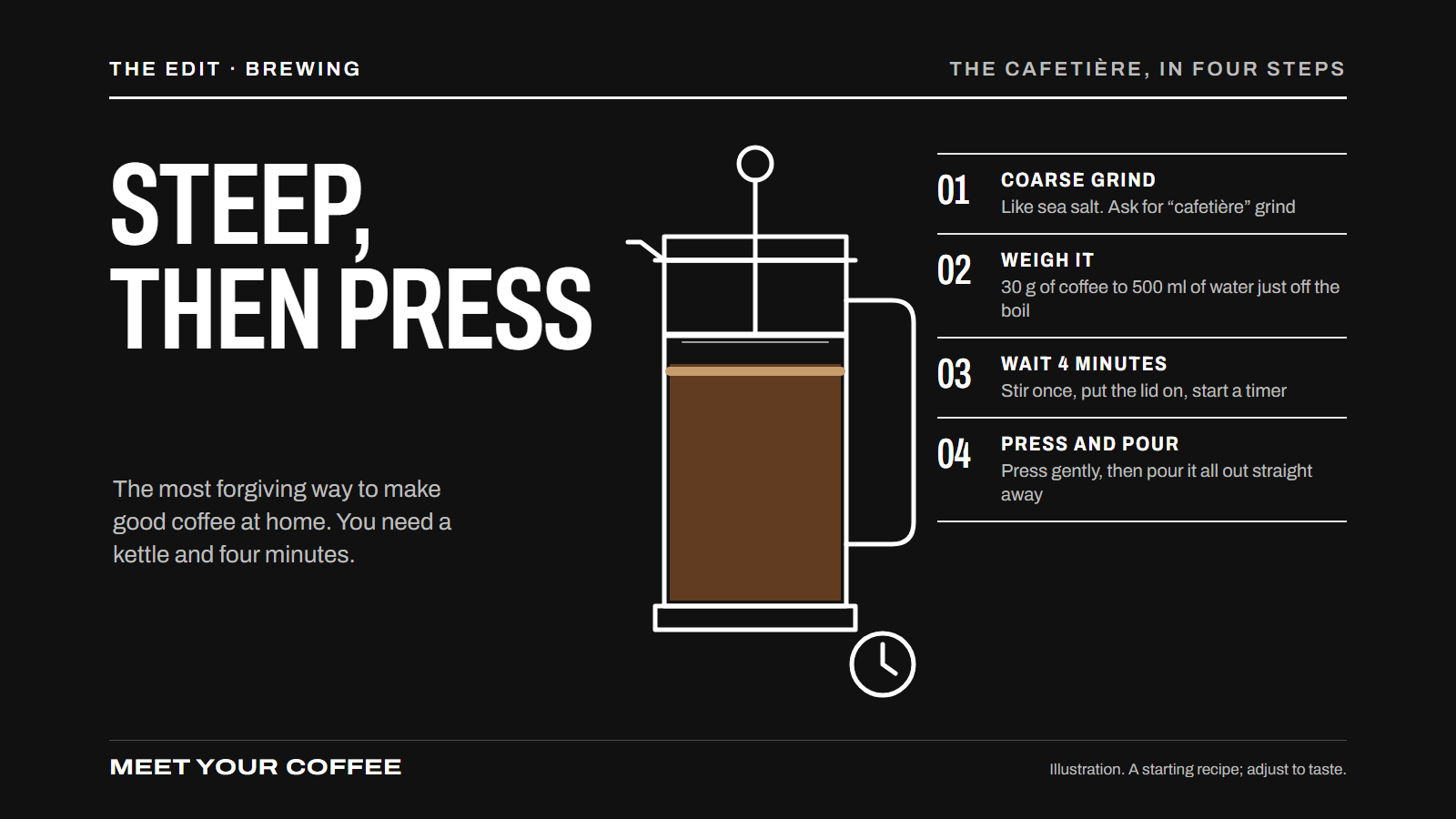
To use a cafetière, add coarsely ground coffee (about 30 g for 500 ml of water), pour on water just off the boil, stir, put the lid on and wait four minutes. Then press the plunger down gently and pour all the coffee out straight away, so it doesn't carry on brewing and turn bitter.
The cafetière, or French press, is the most forgiving way to make good coffee at home. There is no paper, no pressure and no technique to master: just coffee, hot water and time. Get three things right (the grind, the amount and the timing) and it will make a rich, full-bodied cup every morning. This guide takes you through it step by step, with the mistakes to avoid and the coffees that suit it.
What you need
- A cafetière. The common sizes are 3-cup (about 350 ml) and 8-cup (about 1 litre).
- Coffee, ground coarse, or whole beans and a grinder.
- A kettle, and kitchen scales or a tablespoon.
- A timer: your phone will do.
How to use a cafetière, step by step
- Warm the cafetière. Swirl some hot water in it and pour it away. This stops the glass cooling your coffee.
- Add the coffee. Use about 55 to 60 g of coffee per litre of water: 30 g for 500 ml. Bodum, which makes the classic cafetière, suggests one rounded tablespoon per 125 ml cup.
- Add the water. Boil the kettle and let it stand for 30 seconds, so the water is just off the boil. Pour it all in, over all of the coffee.
- Stir and wait. Give it a gentle stir so all the coffee is wet, put the lid on with the plunger pulled up, and wait at least four minutes.
- Press gently. Push the plunger down slowly, with just the weight of your hand. If it is very hard to push, the grind is too fine.
- Pour it all out. Serve straight away, or decant into a jug or flask. Coffee left on the grounds keeps brewing and turns bitter.
Want an even cleaner cup? After four minutes, skim off the foam and floating grounds with two spoons, wait another five minutes for the fine particles to sink, then press only to the top of the coffee and pour slowly. It takes longer, but leaves less sludge in the bottom of your mug.
How much coffee to put in a cafetière
- 3-cup cafetière (350 ml): about 20 g of coffee.
- 4-cup cafetière (500 ml): about 30 g.
- 8-cup cafetière (1 litre): about 60 g.
Too weak? Add more coffee rather than leaving it longer. Too strong? Use a little less coffee or top up the cup with hot water.
What grind should cafetière coffee be?
Coarse, like sea salt. A coarse grind gives a clean, sweet cup and lets the plunger press smoothly. Too fine and the coffee tastes muddy and bitter, the plunger sticks, and fine grit gets through the mesh.
If you don't have a grinder, ask the roaster for a "cafetière" grind. It is the most common grind option in our catalogue: about 1,000 of the coffees UK roasters listed on Meet Your Coffee in October 2026 could be bought ground for a cafetière, usually at no extra cost.
Common cafetière mistakes
- Water straight off a rolling boil. Let it settle for 30 seconds or so.
- Leaving the coffee in the pot. Pour it all out after pressing.
- Pressing too hard. Force sends grounds through the mesh and can crack the glass.
- Old ground coffee. Ground coffee goes stale far faster than beans: the gas and aroma that whole beans lose over weeks escape within minutes of grinding. Buy small bags and keep them sealed.
- A dirty mesh. Old coffee oil in the filter makes every cup taste stale.
What is the best coffee for a cafetière?
Almost any coffee works, which is part of the cafetière's charm. Because the metal mesh lets the coffee's oils through, it brings out body and sweetness:
- For a rich, comforting cup: medium roasts with chocolate, caramel and nut notes, such as Brazilian and Colombian coffees. See chocolatey coffees and nutty coffees.
- For something brighter: a washed Ethiopian or Kenyan gives a juicy, fruity cafetière with more body than the same coffee as filter.
- For milk: a medium-dark roast holds up well. See medium roast coffees.
Cafetière vs filter coffee
A cafetière makes a heavier, rounder cup with more texture; filter coffee is lighter and cleaner, because paper holds back oils and fine particles. Neither is better. If you like the taste of a coffee but want to taste more of its detail, try it as filter: see our guide to filter coffee.
How to clean a cafetière
Tip the grounds into the food waste or compost rather than down the sink. Rinse the pot, then unscrew the plunger now and then and wash the mesh discs in warm soapy water. Most glass and steel cafetières can go in the dishwasher, but check yours first.
What this means when you buy
- Buy whole beans and grind coarse, or ask the roaster for a cafetière grind.
- Buy small bags of ground coffee and finish them within a couple of weeks.
- Medium roasts with chocolate and nut notes are the easy place to start: see Brazilian coffees.
- Read our guide to ground coffee or whole beans before you buy a grinder.
Questions people ask
Is a cafetière the same as a French press?
Yes. "Cafetière" is the usual British name; "French press" and "press pot" are common elsewhere.
How long should you leave coffee in a cafetière?
About four minutes before pressing. Longer extraction makes the coffee more bitter, not stronger in a good way; use more coffee for a stronger cup.
Can you use espresso ground coffee in a cafetière?
It is best not to. Espresso grind is too fine: the coffee turns bitter and muddy, and the plunger is hard to push.
In this story
The 3 coffees mentioned, with today’s price from the roaster. Unavailable coffees are left out automatically.
- £12.35 · 200 g
- £8.00 · 250 g
- £9.95 · 250 g