Guide · 3 November 2026
How is decaf coffee made? The four methods explained
Caffeine is taken out of green coffee before it is roasted. Swiss Water, sugarcane, Mountain Water and CO2, what each does to the taste, and what is left.
By Meet Your Coffee editors
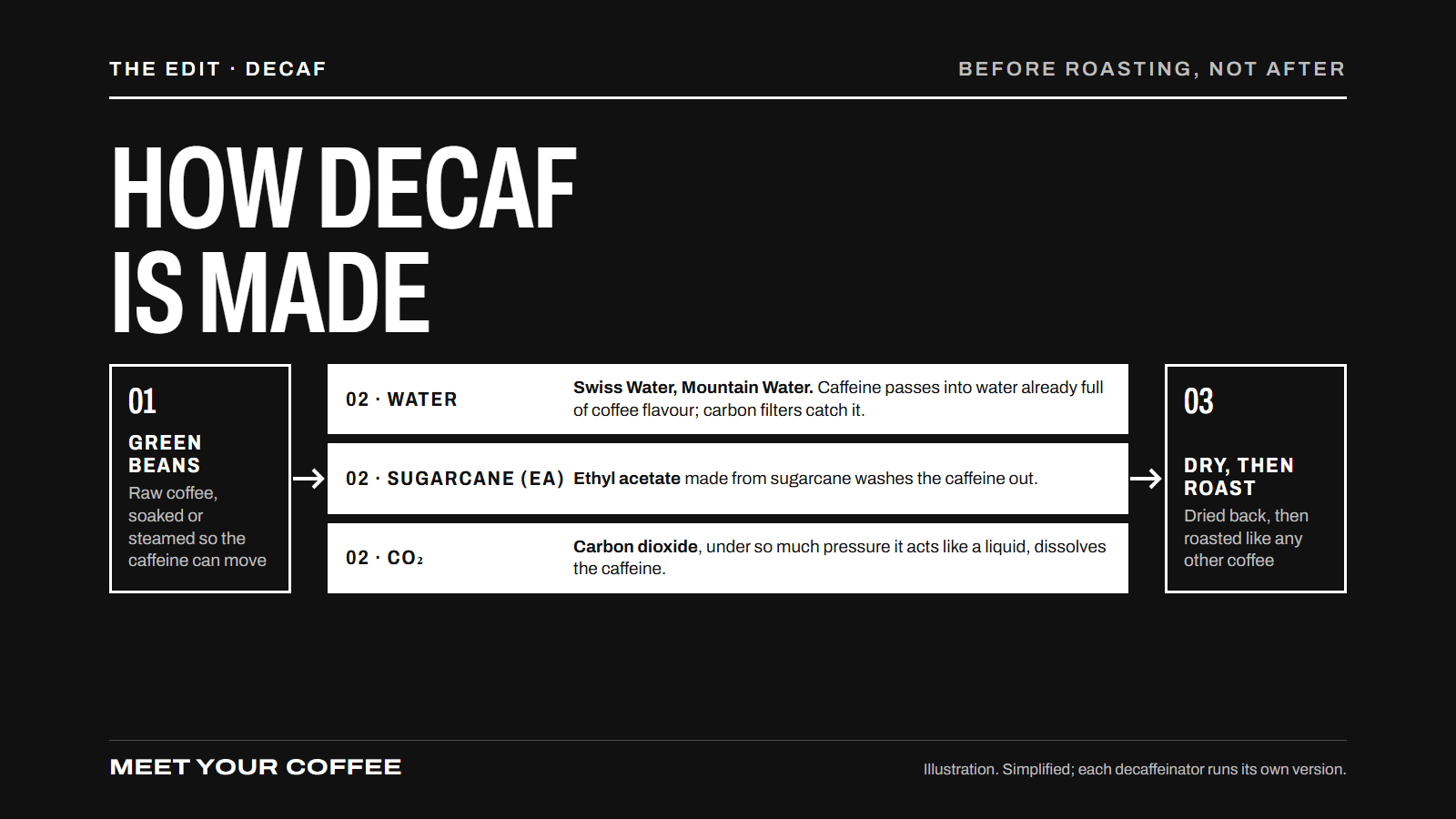
Decaf coffee is made by taking the caffeine out of green, unroasted coffee beans. The beans are soaked or steamed, the caffeine is drawn out with water (Swiss Water, Mountain Water), ethyl acetate made from sugarcane, or carbon dioxide, and then the beans are dried and roasted like any other coffee.
Decaffeination happens at a handful of specialist plants around the world, not at your local roaster. The roaster buys green coffee that has already been decaffeinated, then roasts it. This guide explains the four methods you will see on UK decaf bags, what each does to the taste, how much caffeine is left, and which methods UK roasters use, from the 158 decaf coffees listed on Meet Your Coffee in October 2026.
Why is caffeine removed before roasting?
Because it is far easier to do while the bean is green, dense and full of water-soluble compounds. Every method follows the same three steps: open up the bean with water or steam, move the caffeine out with something that dissolves it, then dry the bean back to its normal moisture so it can be shipped and roasted. The challenge is taking out the caffeine while leaving as much of the flavour as possible behind.
The Swiss Water Process
The Swiss Water Process uses only water, temperature and time. Green beans are soaked in a "green coffee extract": water already saturated with all the soluble parts of coffee except caffeine. Because the water is full of flavour compounds but has no caffeine, mostly the caffeine moves out of the beans. The extract then passes through carbon filters that catch the caffeine, and is used again. The company, based in British Columbia, Canada, says its finished green coffee is 99.9% caffeine-free, and there are no added chemical solvents.
Swiss Water decafs tend to taste clean and gentle. Thirty of the decafs in our catalogue name the Swiss Water Process.
The sugarcane (EA) process
The sugarcane process uses ethyl acetate (EA) made by a sugarcane-based process. The beans are opened up with water and steam, washed in ethyl acetate to dissolve the caffeine, cleaned of the solvent, and dried. It is often done at origin in Colombia, for example by Descafecol in Manizales, close to where the coffee grows.
Sugarcane decafs often taste sweet, with brown sugar, caramel and red fruit. It is the most common method in our catalogue: 49 of the decafs whose roaster names a method.
The Mountain Water Process
The Mountain Water Process is made by Descamex in Veracruz, Mexico, using a water-based extraction rather than an added solvent. Its importers say the water comes from Pico de Orizaba, Mexico's highest mountain. Nine of the decafs in our catalogue name it.
The CO₂ process
Carbon dioxide is put under such high pressure that it behaves like a liquid, and in that state it dissolves the caffeine out of the green beans. No other solvent is added. Only two decafs in our catalogue name it.
What about methylene chloride?
Some commercial decaf is made with methylene chloride (dichloromethane), a solvent that is very effective at removing caffeine. Regulators limit what may remain: in the United States, no more than 10 parts per million in decaf roasted coffee. You rarely see it named on specialty bags; UK roasters who care about decaf usually choose one of the methods above and say so.
Which method do UK roasters use?
Of the 158 decaf coffees in our catalogue in October 2026:
- Sugarcane (EA): 49
- Swiss Water: 30
- Mountain Water: 9
- CO₂: 2
- Not stated on the listing: 67
That more than half name a method shows how seriously UK roasters now take decaf. If yours doesn't, ask them.
How much caffeine is left in decaf?
A little. Decaffeination typically removes around 97% of the caffeine, and the best methods claim 99.9%. There is no UK legal limit for roasted decaf; the usual industry standard is no more than 0.1% caffeine by dry weight, which Germany, for one, writes into law. In the cup, the US Food and Drug Administration says decaf typically has 2 to 15 mg of caffeine in an 8 fl oz (240 ml) cup, against about 100 to 140 mg in a mug of regular coffee by the UK Food Standards Agency's figure.
Does decaf taste different?
Slightly. Every method removes a little more than caffeine, and decaffeinated beans roast a little differently, so decaf can taste a touch softer or flatter than the same coffee before decaffeination. Good decaffeinators and careful roasters keep the difference small. Choosing a decaf with an origin, a method and tasting notes on the bag is the best way to avoid a dull one: see our guide to choosing decaf coffee beans.
What this means when you buy
- Look for the method on the bag; prefer roasters who name it.
- Try a sugarcane decaf and a Swiss Water decaf side by side, and see which you prefer.
- Compare every UK roaster's decaf: decaf coffees, or by brewer, decaf for espresso and decaf for filter.
- You buy from the roaster, on their website. We never sell coffee ourselves.
Questions people ask
Is decaf coffee chemical-free?
Water processes such as Swiss Water and Mountain Water use no added solvent, and neither does the CO₂ process. The sugarcane process uses ethyl acetate, which is cleaned off before the beans are dried and roasted. Every method uses something to carry the caffeine away; the question is what.
Is Swiss Water decaf 100% caffeine-free?
No decaf is completely caffeine-free. Swiss Water says its coffee is 99.9% caffeine-free.
Can roasters decaffeinate coffee themselves?
No. Decaffeination needs industrial equipment, so roasters buy green coffee that has already been decaffeinated at a specialist plant.
In this story
The 3 coffees mentioned, with today’s price from the roaster. Unavailable coffees are left out automatically.
- £19.95 · 350 g
- £13.00 · 250 g
- £11.80 · 250 g