Guide · 3 November 2026
Light vs dark roast coffee: what's the difference?
What roast level means for flavour, body and caffeine, which roast suits your brewer, and why strong on a bag usually means dark, not more caffeine.
By Meet Your Coffee editors
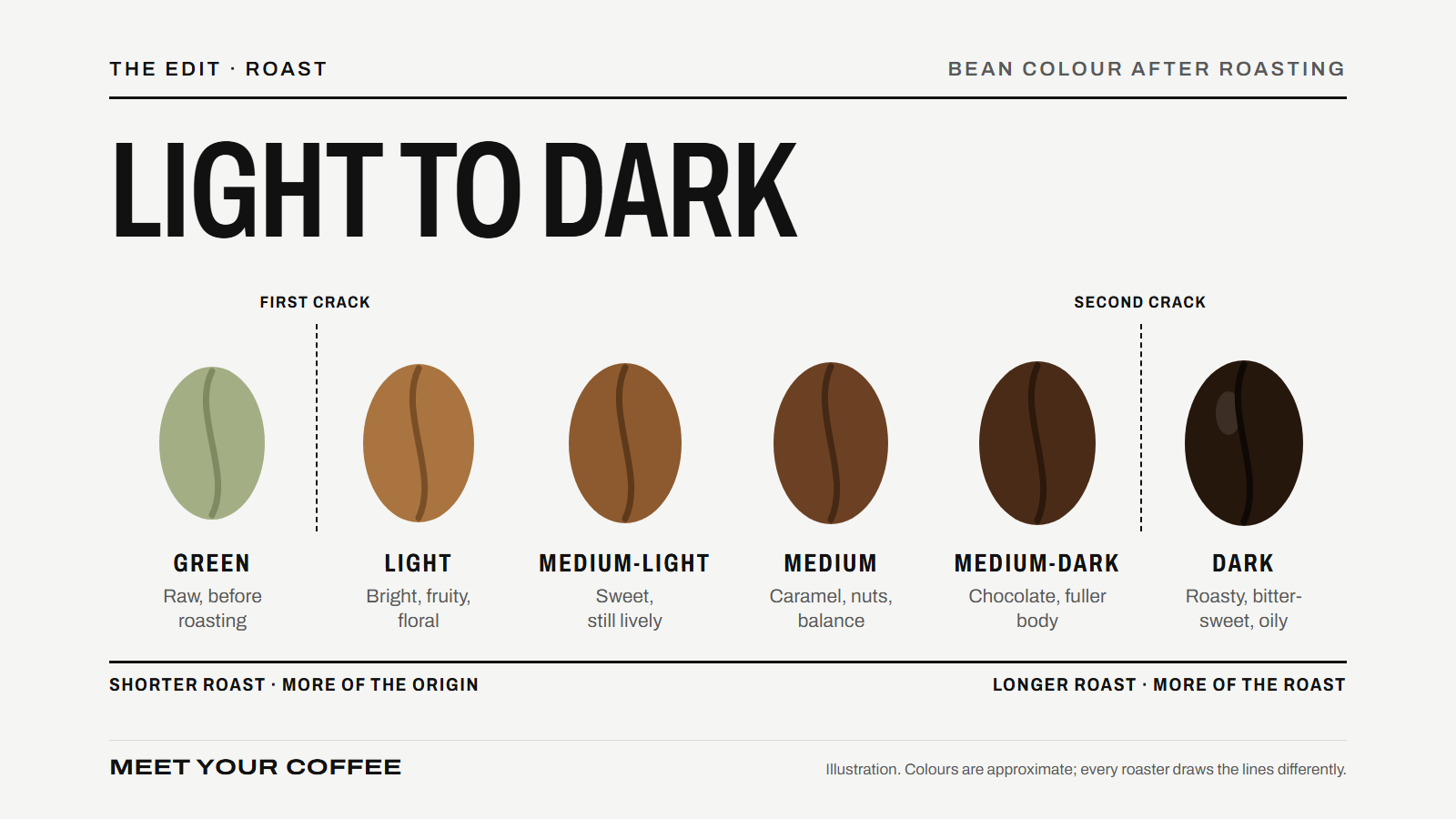
Light roasts are roasted for a shorter time and taste brighter and fruitier; dark roasts are roasted longer and taste roastier, more bitter and fuller-bodied. Medium sits in between. Dark roast does not have more caffeine: weighed out, the roasts are almost the same, and scoop for scoop a light roast can have more.
Roast level is the easiest thing on a coffee bag to understand and the easiest to misread. "Strong" on a supermarket pack usually means dark, not more caffeine, and every roaster draws the line between medium and dark in a slightly different place. This guide explains what each roast level means, how it tastes, which suits your brewer, and what "strongest" really means. The figures come from the coffees UK roasters listed on Meet Your Coffee in October 2026.
What do light, medium and dark roast mean?
Roasting turns hard, grassy green coffee into the brown, aromatic bean we grind. As the beans heat up they dry out, turn yellow, then brown, and at around 196 to 205 °C they make a popping sound called first crack, as steam and gas burst out. A light roast stops soon after first crack. Keep going and the sugars caramelise further and the colour deepens (medium). At around 225 to 230 °C comes a second, quieter crackle, second crack; from there the oils start to rise to the surface and the bean turns dark and shiny (dark roast). Along the way the beans lose 10 to 20% of their weight as water and gases escape, and they puff up and become less dense.
There is no official scale. One roaster's medium is another's medium-dark, which is why it helps to read the tasting notes as well as the roast.
What does each roast taste like?
- Light roast: bright, juicy and fruity, with floral and tea-like notes. You taste more of where the coffee grew. Lighter body, more acidity.
- Medium-light: still lively, but sweeter and rounder.
- Medium roast: balanced: caramel, nuts, milk chocolate, with some fruit. The easiest all-rounder.
- Medium-dark: dark chocolate, toffee, a fuller body and less acidity. Good with milk.
- Dark roast: roasty, smoky and bittersweet, with a heavy body. You taste more of the roast than the origin.
In our October 2026 catalogue, where the roaster stated a roast level, medium was the most common (150 coffees), followed by dark (113), medium-dark (78) and light (77). Many specialty roasters don't state a roast at all and let the tasting notes do the talking.
Which roast has the most caffeine?
Not dark. Roasting longer makes a bean lighter and bigger, because it loses more weight and puffs up more. Weigh your coffee and the difference between roasts is very small: in a test by Cook's Illustrated, light and dark roasts had virtually the same caffeine by weight. Measure by the scoop and light roast can give you much more, because more of its denser beans fit in the spoon; in the same test, 60% more. Other measurements have found smaller differences, so treat the scoop figure as a sign of direction, not a rule.
For reference, the UK Food Standards Agency puts a mug of coffee at about 100 to 140 mg of caffeine.
What is the strongest coffee?
"Strong" means different things:
- Strong in flavour: a dark roast tastes most intense, roasty and bitter.
- Strong in the cup: use more coffee for the same water. That makes any roast taste stronger.
- Strong in caffeine: robusta beans have considerably more caffeine than arabica, about 50 to 60% more by the US National Coffee Association's figure. Most specialty coffee is arabica.
If you like a strong, bold cup with milk, start with dark roast coffees or medium roasts with chocolate notes, and use a little more coffee.
Which roast for which brewer?
- Espresso: medium to dark is easiest, especially with milk. In our catalogue, dark roasts were labelled for espresso twice as often as for filter. See espresso coffees.
- Filter and pour-over: light to medium, to show off fruit and clarity. Light roasts were labelled for filter three times as often as for espresso. See filter coffees.
- Cafetière: anything works; medium is a safe start.
- Moka pot: medium to medium-dark.
- Bean-to-cup machine: medium to medium-dark. Avoid very dark, oily beans: De'Longhi warns that oily, caramelised or coated beans can stick in the grinder and damage it.
Why don't roasters use the same names?
Because roast level is a range, not a fixed point, and every roaster's machine and style differ. You will also see roasts named after a brewer rather than a colour: an "espresso roast" or "filter roast" means the roaster has developed it for that method, and "omni" means it is meant to work for both. Read the tasting notes alongside the roast: "blueberry, jasmine" tells you it is light; "dark chocolate, molasses" tells you it is darker.
What this means when you buy
- Bright and fruity: light roast coffees.
- Balanced, sweet all-rounders: medium roast coffees.
- Bold, roasty, good with milk: dark roast coffees.
- Match the roast to your brewer, and read the tasting notes as well as the roast.
Questions people ask
Is blonde roast the same as light roast?
Roughly. "Blonde" is a coffee-chain name for a lighter roast. Specialty roasters usually just say "light".
Why are dark roast beans oily?
Long roasting drives oils from inside the bean to the surface. Shiny beans are a sign of a dark roast, not of freshness.
Which roast is least acidic?
Darker roasts taste less acidic. If acidity bothers you, try a medium-dark or dark roast, or a Brazilian coffee, which tends to be low in acidity.
In this story
The 3 coffees mentioned, with today’s price from the roaster. Unavailable coffees are left out automatically.
- £12.00 · 200 g
- £10.75 · 250 g
- £8.45 · 200 g